Conjecture 109.
Another test of Primality
On Jan 1, 2026 Sebastián Martín Ruiz sent the following
Conjecture.
Conjecture:
p>3,  p=3 (mod 4) p is prime
if and only if
(1+i)^p=1-i (mod p) and (1+2i)^p=1-2i (mod p).
Q1. Prove this conjecture or
find a counterexample.
Q2. This conjecture has been
tested up to p<10^9. Can you test it
far beyond?
Q3. Send the largest prime
(original of you or not) that you can prove using this test, reporting the
time spent in your computer.
Additional notes by SMR:
a) The
test of Lucas-Lehmer for Mersenne primes Mp has a complexity
O(p^2 log p log log p)
and the conjecture test has a complexity O(p^3),
but the conjecture test is for all type of primes
b) Congruences modulo p are also defined for Gaussian integers, which are
complex numbers
of
the form a+bi with a and b being integers. It should be noted that this
Conjecture is an equivalence; that is, it is enough to prove both
congruences and the number will be prime. Two other complex numbers other
than 1+i and 1+2i could also be used, but the larger the modulus, the slower
the calculation.
c) With my PC computer, I have verified this
well-known prime
p=2996863034895*2^1290000-1 of approximately
360,000 digits and it took 17 hours and 11 minutes of CPU
time.
d) The MATHEMATICA program has a function that
performs these PowerMod congruences,
and when applied twice:
PowerMod(1+i,p,p)=1-i
PowerMod(1+2i,p,p)=1-2i
checks if p is prime.
This is a polynomial-time
algorithm, and with a good computer, it would be possible to check
the largest known primes, that is, the Mersenne
primes, the largest
of which has 41 million digits.
e) Curiously, for very large primes, the vast
majority already tested & reported are congruent to 3 (mod 4). Those
congruent to 1 (mod 4) are very rare.
f) Comparative times table,
running both tests in SMR PC:
Mersenne prime, Test Lucas Lehmer time, SMR Conjecture Time
M86243, 36.7 sec, 106.4
sec
M132049, 77.7 sec, 291.2 sec
M216091, 246.4 sec, 781.9
sec

During January 10 to 16,
2025, contributions came from Emmanuel Vantieghem
***
Emmanuel wrote:
I could not find a counterexample below 10^12.
If we restrict m to Mersenne numbers (i. e. : numbers of the form 2^p
- 1)
I found no counterexample with p < 59600.
However, it is easy to prove that the first congruence always holds for
such numbers:
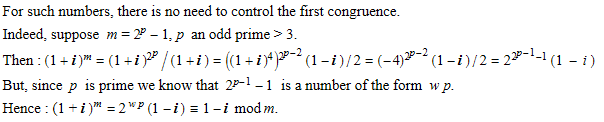
In my opinion there might be a proof for the second congruence too, but
at this time I do not see how.
***
On Jan 20, 2026, Alessandro Casini wrote:
Here are some observations about the conjecture.
It's easy to check that both conditions are satisfied by every prime p ≡ 3
(mod 4). Indeed, if p is prime then (1+x)^p ≡ 1+x^p (mod p), since all the
intermediate binomial coefficients are divisible by p. In particular,
(1+i)^p ≡ 1+i^p ≡ 1−i (mod p), and similarly (1+2i)^p ≡ 1+2^p i^p ≡ 1−2i
(mod p), where Fermat’s little theorem is used. A more conceptual way to say
this is that, in Z[i]/(p), the Frobenius map acts as complex conjugation.
Using the same argument, one sees that for p ≡ 1 (mod 4) the congruences are
conjugated instead.
The real interest of the conjecture obviously is the converse direction.
For the first condition, one can explicitly compute the real and imaginary
parts of (1+i)^p; these turn out to be alternating sums of binomial
coefficients with even and odd indices. Somewhat unexpectedly, this shows
that the first condition is exactly equivalent to p being an Euler–Jacobi
pseudoprime to base 2. Therefore, any possible counterexample must lie among
these numbers (OEIS A047713). From a computational point of view, the test
has cubic time complexity.
For the second condition, an explicit expansion doesn't seem to be
available, so I can't translate it into a clean equivalent statement. Still,
by comparing the norms modulo p on both sides, one finds that this condition
forces p to be a Fermat pseudoprime to base 5 (OEIS A005936), which further
narrows the list of potential counterexamples.
It seems likely that some additional input is needed, either from the theory
of Gaussian integers (where primes congruent to 3 (mod 4) play a special
role) or by Algebra's tricks. In the end, the conjecture can be summarized
rather neatly as saying that if the Frobenius automorphism acts like complex
conjugation on two independent Gaussian integers modulo p, then p must be
prime.
In any case, I bet the conjecture is true.
After I (CR) asked Alessandro the following: "What
do you think about the claim by Sebastian that this test can compete in
speed with the alternative primality tests for Non-Mersenne candidates to be
primes?", he responded:
If it were true, certainly. Other polynomial algorithms
are:
-
Deterministic Miller-Rabin: O(n^4) assuming unproven GRH
-
ECCP: heuristically n^4/n^5, but produce a certificate
-
APR-CL: actually asymptotically between polynomial and exponential
-
AKS: n^6. Lowers to n^3 if Agrawal's conjecture were true
The comparison of times should also be verified at the computational
level.
Regarding the same questions
Mr. Emmanuel Vantieghem, responded: "Frankly,
I still think there are counterexamples"
So, in order to decide this Conjecture we
need a complete demonstration or a simple counterexample.
***
On Feb 22, 2026 Sebastián Martín Ruiz wrote:
M. F. Hasler sent me this found by him on Internet. For me, it is
something alike to my Conjecture 109 but a little more complex.
https://mathoverflow.net/questions/374831/primality-test-for-numbers-of-the-form-4k3
***


