Problems & Puzzles: Puzzles
|
Problems & Puzzles: Puzzles
 From June 12 to 18, 2026, contributions came from Michael Branicky, Simon Cavegn: *** Michael wrote: I found no larger examples in a search up to 10^12 (that is, 12 digits and less). *** Simon wrote: Could not find a larger solution up to 18234000000000. ***
Ashaz Jameel wrote on 27 June 2026:
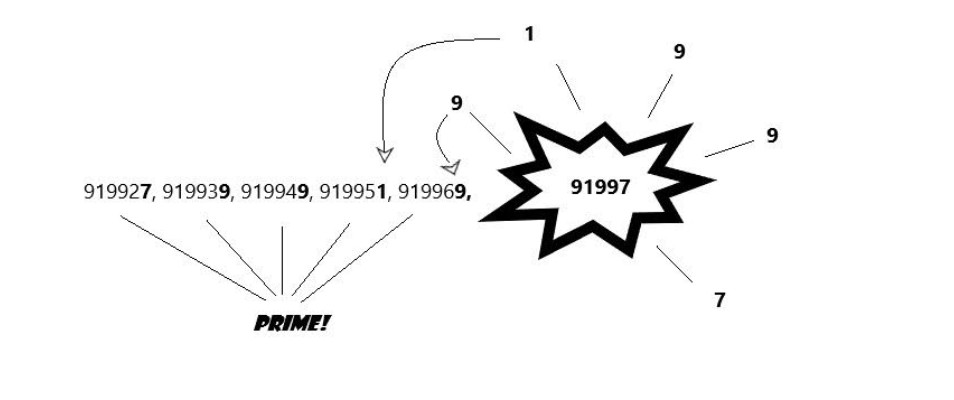
I believe that there are only a finite number of primes of this form (if any other examples even exist). The prime number must only contain the numbers {1,3,7,9} (as any other number would be divisible by 2 or 5).For the first part of the preceding numbers (e.g. 91996, 91995...) they differ by 10 ≡ 1 mod 3 => one in every 3 numbers can't end in {3,9} as then they would be a multiple of 3. Following this logic, one in every 7 numbers can't end in a 7 for the same reason. Therefore, one in every 3*7=21 numbers can't end in a {3,7,9} => it ends in a 1. But considering mod 11, every 11 numbers a given number is congruent to -1 mod 11 => it can't end in a 1. Combining this, we get that one in every 3*7*11=231 numbers can't end in a {1,3,7,9} => it cannot end in any number. Therefore, the upper limit to primes of this form is 10**231. Whilst computationally we haven't gotten near this limit, I bet that you could probably reduce this down further. ***
|
|||
|
|||
|
|||