|
Problems & Puzzles:
Puzzles
Puzzle 1282 Prime
Square-Row Triangles
On September 9, 2026,
Tesfamichael B. Bogale sent the following puzzle:
Let p be a prime. Build a triangle of primes as
follows:
Row 1 contains just p.
Row k (k =
2, 3, 4, ..., n) contains the next (2k - 1)
consecutive primes, carrying on from
wherever the
previous row left off.
So the row sizes are
1, 3, 5, 7, 9, ..., n. After n rows, exactly n^2
primes have been used in total.
For each n
value is required that the sum of the primes in each
row, 1, 2, ...,n is a prime value too. The triangle
ends when the sum of he primes in the row n+1 is a
composite.
Examples:
Example 1 (p =
2):
Row 1: 2 (sum = 2
prime, trivial)
Row 2: 3, 5, 7 (sum = 15
composite)
Example 2 (p = 3):
Row 1:
3 (sum = 3 prime, trivial)
Row 2:
5, 7, 11 (sum = 23 prime)
Row 3:
13, 17, 19, 23, 29 (sum = 101 prime)
Row 4:
31, 37, 41, 43, 47, 53, 59 (sum = 311 prime)
Row
5: 61, 67, 71, 73, 79, 83, 89, 97, 101 (sum = 721
composite)
I have found the smallest p, Sp,
for the first eleven n values:
Table 1
|
n |
Sp |
|
1 |
2 |
|
4 |
3 |
|
2 |
5 |
|
3 |
7 |
|
5 |
13 |
|
6 |
47 |
|
7 |
2,052,907 |
|
8 |
181,475,509 |
|
9 |
3,315,167,663 |
|
10 |
284,388,908,269 |
|
11 |
933,262,755,767 |
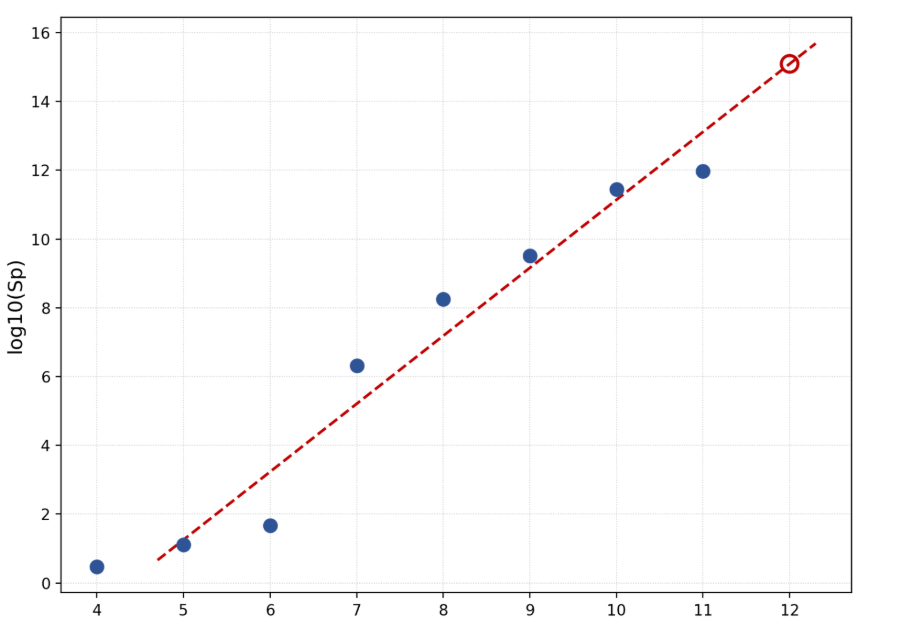
Plotting log10(Sp) against n shows a
striking near-linear trend. A least-squares fit over
n = 5...11 gives log10(Sp) = 1.976n - 8.626 (R2 =
0.945). Extrapolating the fitted trend forward gives
a rough order-of- magnitude estimate for Sp for n=12
of ~1.2 x 10^15.
Graph 1
Q1. Can you
verify the values in the Table 1
Q2. Can you
extend the Table 1, or at least get Sp for n=12?
|
|
|
|

|


